
The experiment
REDTOP (Rare Eta/Eta’ Decays TO Explore New Physics) is a proposed low-energy, fixed-target meson factory. High-intensity proton accelerators offer a rare opportunity: produce unprecedented samples of η and η’ mesons-up to 1014 particles over a decade. Such statistics open a direct path to test fundamental symmetries and to discovering light dark matter and probing New Physics (NP) in the MeV–GeV range.
An η/η’ factory is a uniquely powerful tool for studying rare processes and beyond–Standard Model (BSM) phenomena at low energies, where there are strong theoretical motivations for new physics. REDTOP belongs to the high-intensity frontier: it searches for small deviations from the Standard Model by analyzing extremely large event samples produced with an intense beam.
The η and η’ mesons are unique particles since they carry the same quantum numbers as the Higgs (except for parity), and have no Standard Model charges. Their decays are flavor-conserving and most of them forbidden at leading order (in various symmetry-breaking parameters) within the Standard Model, making them ideal for detecting faint signals from New Physics.
New Physics is expected to be neutral under Standard Model (SM) charges. Consequently, its production in the decays of η and η’ mesons proceeds without the involvement of SM charged currents, unlike the case of heavy-flavor mesons, whose decays are mediated by charged-current interactions.
Therefore, an η/η’ -factory offers a cleaner experimental environment for probing rare decays predicted by theories beyond the Standard Model (BSM).
The experimental reach of REDTOP aligns naturally with the broader U.S. particle physics program as outlined by P5 and in the U.S. national input to the European strategic planning process.
REDTOP will serve as a multidisciplinary training platform for early-career researchers in physics, engineering, and data science, fostering the development of highly skilled professionals vital to US’s innovation ecosystem.
By broadening the Fermilab scientific portfolio and strengthening international collaboration, REDTOP reinforces research infrastructure and advances US’s leadership in frontier science. As demonstrated historically, breakthroughs in fundamental physics frequently enable transformative technologies; REDTOP likewise has the potential to catalyze future innovations with wide transformative impact.
REDTOP would use a 1.8 GeV continuous-wave (CW) proton beam impinging on a target consisting of ten foils of a low-Z material (lithium or beryllium). This configuration is expected to produce about 1014 mesons in three years of running. A detector surrounding the target would measure the η decay products, with particular sensitivity to channels that are forbidden or highly suppressed in the Standard Model—down to branching fractions at the 10-11 level. In addition, η and η’ decays can produce light dark matter candidates that REDTOP could detect, along with a broad range of other BSM signatures.
The REDTOP Collaboration has been working on the design of the experiment for nearly a decade, and the concept is now quite mature. Read more details in the physics processes of interest for REDTOP or the Snowmass 2022 White Paper.
The beam
One of the most challenging aspects of REDTOP is related to the design of the proton beam required to produce the desired number of η/η’ mesons. The kinetic energy of that beam, in fact, needs to be high enough to generate the η mesons inside the target but, at the same time, not too high so that the background is kept at manageable levels. Detailed Monte Carlo simulations indicate that a beam energy of 1.8 GeV is optimal for the experiment. Furthermore, the beam time structure needs to be as uniform as possible, in order to allow the detector to collect, skim and transfer the information to the data storage.
Several laboratories could provide a proton beam with the specifications above, therefore several options are currently being explored:
Fermilab Delivery Ring
Fermilab is developing its new Muon Campus to provide beam for the Mu2e experiment. At center stage of the complex is the Delivery Ring (DR). For Mu2e, the 8 GeV protons (8.9 GeV/c) will be transferred directly from the Recycler into the Delivery Ring (DR). The ring will have RF cavities for maintaining bunched beams as well as a slow resonant extraction system for use during Mu2e running. Though, Mu2e will run the DR at constant field (like previously g-2), an additional RF cavity and improvements to the power supply system of the DR would allow the DR to decelerate the beam to lower energies such as those required for REDTOP. Hence, such enhancements to the DR would open up a new realm of lower-energy, high rate experiments and expanding the upcoming Muon program. Read a more detailed discussion of the accelerator complex for REDTOP.
Fermilab PIP II
An upgraded version of REDTOP could be run in a later stage of the experiment at the PIP-II facility currently under construction at Fermilab. At PIP-II accelerator complex, the η mesons will be produced in tagged mode with an increased sensitivity of the experiment to New Physics.
ESS
There exist two options for running REDTOP at the European Spallation Source (ESS). The simplest option would be to employ a primary proton beam from the ESS linac. As already mentioned, the REDTOP beam requirements are modest in terms of intensity. Only 1 × 10¹¹ protons on target per second are needed on average, ideally in a continuous-wave (CW) mode, at a beam energy of at least 1.8 GeV. Since the ESS linac aims at delivering 5 MW beam in 2.86 ms long pulses of protons at 14 Hz, there are a number of ways to extract the merely 30 W for REDTOP, with pile-up in the detector being the limiting factor to the peak beam intensity.
GSI SIS18
The High-Energy Beam Lines (HEST) at GSI s a set of beam lines between SIS-18 synchrotron, ESR, Cryring storage rings and experiments, with a total length of about 600 meters. The proton beam can reach energies up to 2 GeV/u and intensities up to 1011 protons per spill. The beams are extracted from SIS-18 in both: slow and fast extraction modes. The extraction mode and the intensity available fullfil the beam requirements for REDTOP. In particular, the beamline optimized for the production of a secondary pion beam could be used for the production of η mesons on REDTOP target systems. The residual proton beam (approximately 99% of the primary protons) could be transported to the pion target to run the pion program at GSI.
HIAF Multi-terminal
The heart of HIAF accelerator complex is a Booster Ring delivering protons or ions to several extraction halls (Terminals). The Multi-function terminal can easily accommodate the REDTOP detector. The beam at that terminal could reach an energy above 9 GeV and an intensity exceeding 1013 protons per second, about two orders of magnitude higher than required. The structure of the beam can be adapted to REDTOP by a slow-extraction method with a long top-off, making it very close to a CW beam.
The detector
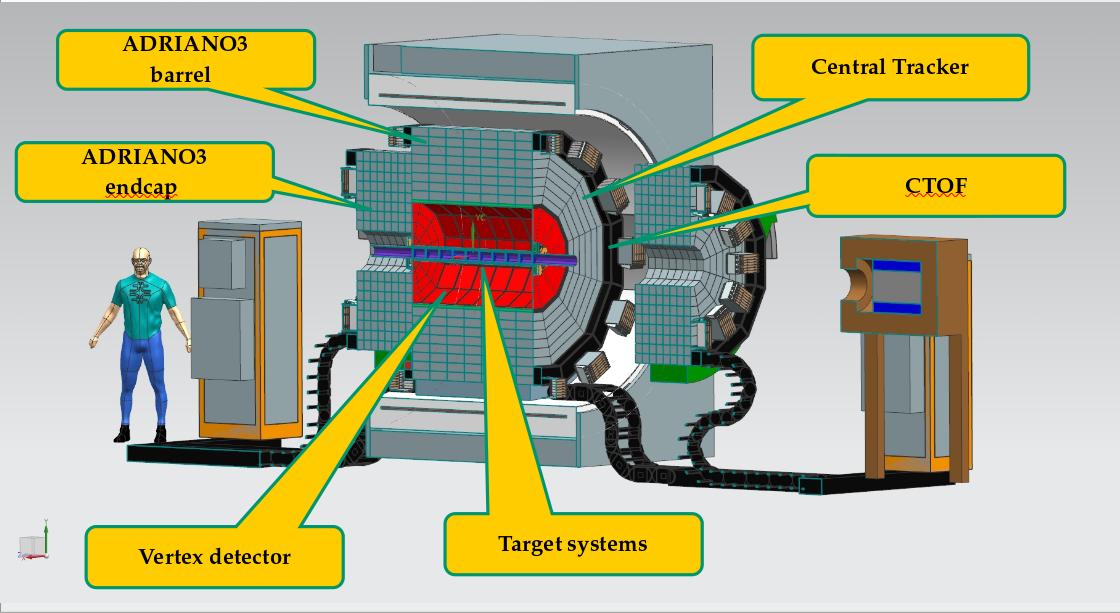
To search for NP, REDTOP will involve the development and first use of innovative detectors. The detector being designed for the REDTOP experiment will exploit novel technologies aimed at a highly granular, nearly hermetic apparatus, with fast timing (~30 psec) and excellent particle identification. This will enhance the sensitivity of the experiment to a rich and broad physics program, exploiting different beam energies and beam configurations. Novel instrumentation will include a super-light vertex detector, a Low Gain Avalanche Detector(LGAD)-based central tracker with unprecedentedly low material budget a triple-readout calorimeter (ADRIANO3), and a ˘Cerenkov Threshold Time-of-Flight(CTOF). An optional Active Muon Polarimeter is being considered to improve the measurements of the muon polarization.
Read a more detailed discussion of REDTOP detector.
The science program
The physics opportunities offered by an η/η’ factory have been discussed in great detail in the Snowmass 2022 White Paper and are summarized on the physics program page. The runs planned for REDTOP are described at the following link.
However, more experiments could be envisaged with eventual modifications or upgrades of the detector. These will encompass runs with muons or kaon beams and with different targets. The high granularity of the calorimeter could be exploited at an EDM experiment, as the inelastic events, diluting the EDM measurement, would be rejected with a larger efficiency than with a more conventional polarimeter.